What happened at the Taipei fan sign
Soomin of tripleS has apologised after a look she wore at a fan sign event in Taipei became the centre of a cultural appropriation row. According to Koreaboo's reporting, the group was in the city this week for the event, where fans brought costumes and accessories for the members to put on. One of those items, given to Soomin, was photographed on her and quickly travelled far beyond the room.
The outfit consisted of a white thobe and a ghutra headpiece held in place by an agal, replicas of traditional dress worn by Arab and Muslim men across the Gulf region, both as everyday clothing and as religious dress. Soomin also wore a stuck-on beard and moustache. Photographs from the event circulated online, and the combination of the garments with the facial hair is what turned a fan-event costume into a controversy that has now drawn in the group's agency and the wider fandom.
Koreaboo's report does not establish how the look came together beyond the fan sign setting: the costumes were supplied by fans, and the styling was worn in a public event with staff present. That gap matters, because much of the argument that followed has been about who should have stopped it rather than about what Soomin intended.
Soomin's apology and what it covered
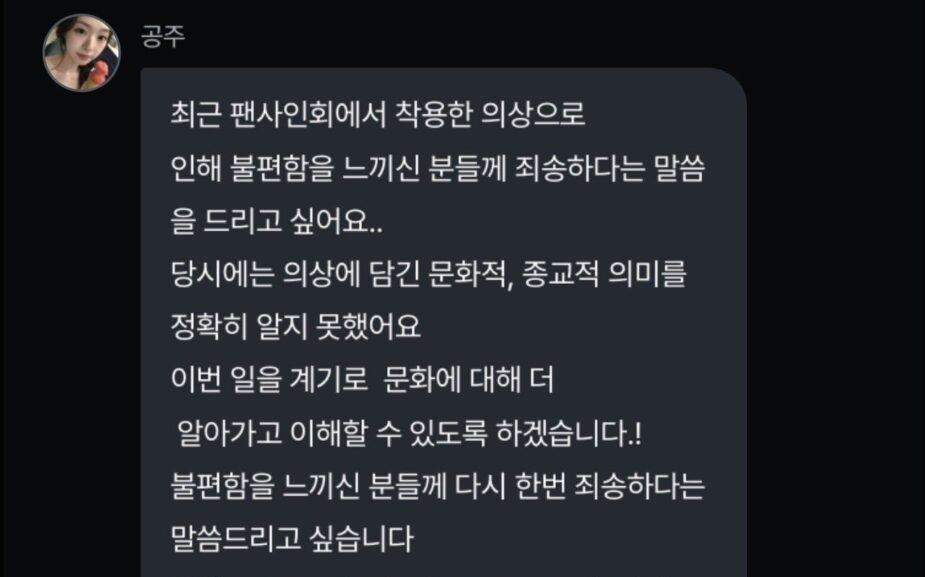
Soomin addressed the backlash directly, in a message to fans on Cosmo Talk rather than through a formal agency statement. She said she had not fully understood the cultural and religious significance of the outfit at the time, apologised to those who felt uncomfortable, and described the incident as a chance to learn more about and better understand the culture.
It is a short and fairly conventional idol apology: prompt, personal, focused on the offence taken rather than on defending intent. Its speed is notable, arriving shortly after the photographs went viral, and it addresses the substance of the criticism — that the garments carry meaning beyond costume — without disputing that the look happened.
What it does not do is explain the decision-making around the outfit. Whether the beard and headpiece were assembled by Soomin, suggested by someone in the room, or handed over ready to wear is not set out in the apology or in the reporting. Fans who want accountability from the company and event staff have therefore read the message as a starting point rather than a conclusion.
Why this particular look landed so heavily
The thobe, ghutra and agal are not generic festival dress. They are everyday clothing across Gulf countries and are worn in religious contexts as well, which is why critics treated the styling as more than a fashion misstep. Adding a stuck-on beard pushed the look towards impersonation, and that is the element that many of the angriest responses focused on.
The context of the event sharpens the point. A fan sign is a playful space, and dressing an idol in a supplied costume is part of the give-and-take that fans enjoy. But playfulness is exactly what makes some looks read as mockery, whether or not mockery was intended. Critics argued that turning religious and regional dress into a comedy prop — complete with facial hair — invites people to laugh at the outfit rather than with it.
That interpretation is contested, and it is worth separating the arguments. Some fans said they found the look inoffensive, stressing that Soomin did not perform a caricature or say anything mocking. Others, including fans describing themselves as Muslim, said the lack of ill intent did not cancel out the effect, and placed the episode in a longer pattern of normalised disrespect they say they encounter in K-pop fandom spaces.
A fandom split over responsibility
The reaction on social media divided quickly, and not along a simple offence-versus-defence line. One camp defended Soomin on intent, arguing that she wore what she was given, posed for photographs and did nothing to ridicule anyone, and that blame belongs with the fan who supplied the outfit and the staff who allowed it through.
Another camp accepted that intent was not the issue. These fans argued that ignorance is still the idol's problem to fix, praised the apology as a first step, and pushed for Soomin to educate herself. A third strand of response was openly frustrated at the company, with fans demanding that Modhaus, staff named in fan posts in connection with the event, and the person who brought the outfit come forward and take responsibility.
The split is instructive. Fandom arguments about cultural appropriation often collapse into whether a particular fan was offended, which is a question no one can settle for anyone else. Here, the more productive disagreement was about systems: who sources costumes, who approves them, and what a company owes when something slips through at an event it runs.

The staff question that outlasts the apology
Fan signs are unusually uncontrolled environments by K-pop standards. Fans bring gifts, accessories and outfits, and idols are photographed wearing or holding them within minutes, often in front of cameras that broadcast the result instantly. That format produces the intimate moments fans value, but it also means an item can go from a bag to a viral image faster than any review process can operate.
The obvious lesson is not that fan signs should stop, but that the people running them need a way to pause. A stylist or manager who recognises a garment as religious dress, or a beard as a costume with a specific history, can intervene before the photograph exists. The difficulty is that this requires cultural knowledge to be present in the room, not just in a statement issued afterwards, and the reporting does not indicate whether any such conversation took place.
There is also the fan's role to consider. Fans bring these items precisely because they want a moment of closeness, and most such gifts are harmless. But when a costume carries religious weight, the responsibility does not disappear because it was offered with affection. The controversy has made that awkward, and it is the part of the story least likely to be resolved by a single apology.
What the response says about how K-pop handles these rows
The pattern here will be familiar to anyone who follows K-pop: a photograph, a wave of criticism, a fast personal apology, and an unresolved question about whether the company will say anything at all. Idols are expected to front these moments themselves, which puts a great deal of cultural education on individuals who are often young and working within tightly managed schedules.
That is not an argument for leniency so much as a description of where the pressure lands. Soomin's apology takes responsibility and commits to learning, which is more than a defensive statement would have offered. But an idol's promise to learn is not the same as a company changing how it vets what fans bring on stage, and fans asking for a Modhaus response are asking for the second thing.
Koreaboo's reporting notes that the controversy prompted demands for an apology from the agency and event staff; it does not include any statement from Modhaus or from the event organisers. Readers should treat the company's position as unconfirmed rather than as a refusal, and the story may well develop further.
It is also worth being precise about what the episode is not. There is no indication in the reporting that Soomin set out to mock Arab or Muslim people, and the fans defending her are not inventing that reading. The criticism that has stuck is about the gap between an outfit's meaning and the person wearing it — a gap that education can close, but only if the people around the idol are willing to close it too.
The takeaway
Soomin has apologised clearly and quickly for wearing a thobe, ghutra and fake beard at a fan event in Taipei, acknowledging that she did not understand the cultural and religious significance of the outfit. The apology answers the question of whether she is willing to take the criticism seriously. It does not answer the question of how a costume with that meaning reached the stage of a publicly photographed event in the first place.
The useful test now is not whether fans found the look offensive — they clearly disagree — but whether the next fan sign has someone in the room who would stop it. Everything else, including the company's eventual response, follows from that.
If you have thoughts on how costume requests at fan events should be handled, the discussion thread is open below.