
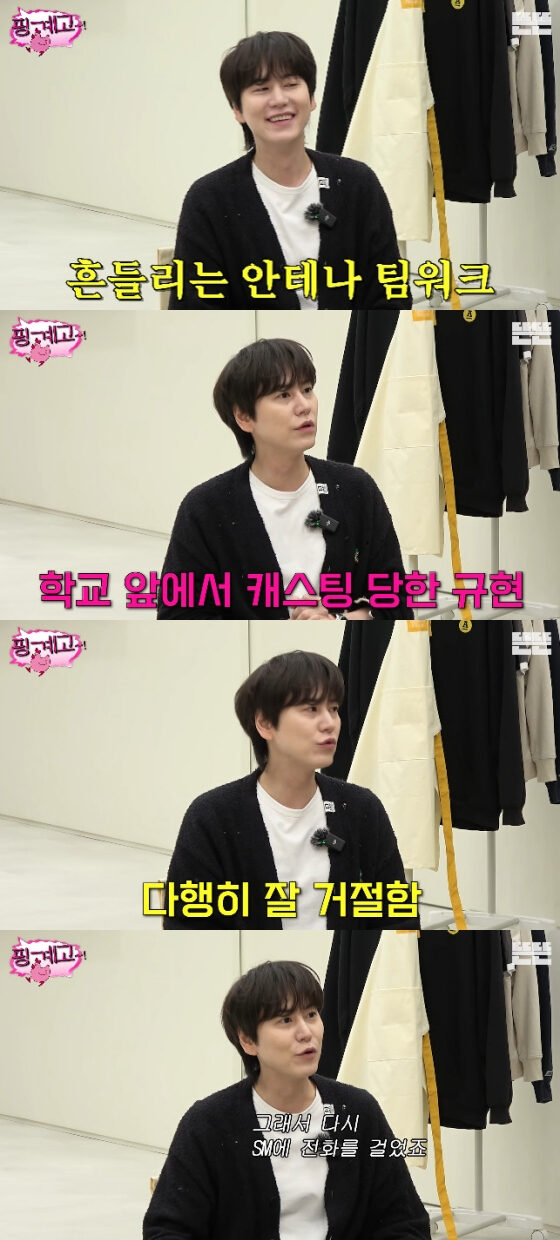
Kyuhyun tells Ddeun Ddeun how quickly his debut took shape
Super Junior's Kyuhyun has opened up about the uneven path that took him to SM Entertainment, including a casting approach that came with a demand for money and an initial decision to turn down the company that would eventually launch his career. Koreaboo reported his comments from an episode of the YouTube channel Ddeun Ddeun, released on 24 October, under the title '2nd Generation Idols are Just Excuses'. The clip also featured Yoo Jae Suk, whose teasing helped draw out the story.
Kyuhyun described a trainee period of roughly one year before Super Junior's debut. What made that period unusual, in his telling, was how quickly he was folded into the debut preparation. He said he joined the debut team as soon as he entered the company and was told almost immediately that he was going to debut.
That detail gives the story its shape: this is not a account of years of uncertainty inside a training system, but of a singer who arrived and was rushed into a lineup, with all the pressure that implies.
The conversation moves between humour and the practical realities of building a career. Yoo Jae Suk's jokes keep the tone light, while Kyuhyun's answers return to the decisions that shaped his entry into the industry. The result is a pre-debut story that is less about a straight ascent than about detours, missed contacts and a second chance.
The street casting that came with a ₩100 million condition
Before any SM Entertainment contract entered the picture, Kyuhyun was approached in front of his school. He recalled being street-cast, but not because of his vocals. He went for a test and passed straight away. Then came the condition that made him walk away: he says he was asked for money. The sum was around ₩100 million, or about $75,600, and the request came roughly 23 to 24 years ago.
Kyuhyun said he thought the demand was wrong and declined. The company behind that request is not named in the report, which keeps the focus on his decision rather than on the identity of the outfit. The detail is nonetheless striking because it separates two things that can be blurred in pre-debut stories: being wanted for a test, and being asked to pay for the opportunity. In Kyuhyun's account, passing the test did not make the offer acceptable once money became part of it.
The amount also gives the story a scale that is easy to grasp. A request of that size would be a serious commitment for a young trainee and his family, not a minor fee. Kyuhyun frames his response simply: he thought it was wrong, so he said no. That moment becomes the first of several points in the story where he chooses not to proceed, only for another route to open later.
Why the payment request stands out in his account
Casting stories often turn on the moment an idol is spotted, but Kyuhyun's account lingers on what happened after the test. The payment request is the part that turns a familiar discovery narrative into something more complicated. It also shows how quickly a promising approach can become a decision about boundaries. Kyuhyun does not present the episode as a dramatic turning point; he describes it as a reason to decline and moves on.
That restraint is part of what makes the story useful. It does not require a claim about how common such requests are, nor does it ask listeners to generalise from one case. The verified detail is narrower: Kyuhyun says he was asked for a large sum after passing a test, and he refused. The reported account gives readers a concrete example of how a pre-debut opportunity can arrive with strings attached, without turning that example into a wider industry rule.
It also sits alongside the later SM Entertainment story in an interesting way. Kyuhyun was willing to reject an offer that felt wrong, even when it had begun with a successful test. Later, he would also reject SM's first approach. The pattern is not indecision so much as a willingness to say no when the terms or the timing did not suit him, before eventually finding a route he was prepared to take.
The first SM offer he turned down
Kyuhyun's path to SM Entertainment was not a simple case of being scouted and signed. He said SM offered him a test, but he initially declined. At the time, he was not aiming at idol companies for casting. He had won the gold prize at the Buddy Buddy Star Contest, and a teacher, Park Sun Zoo, was going to help him develop. His ambition, as he describes it, was to become a ballad singer.
That context explains why the first SM offer was not automatically attractive. He had a contest result, a mentor and a preferred direction. An idol company's casting process may have looked like a different path from the one he had in mind. The story therefore adds a useful distinction: being offered a chance is not the same as being ready to accept it, especially when a young singer already has another plan.
The plan then ran into a practical problem. Kyuhyun said he lost contact with Park Sun Zoo, who seemed to be very busy. The promised help did not disappear in a dramatic falling-out; it simply became harder to reach. That gap left him without the support he had been counting on and helped push him back towards the SM option he had previously set aside.
A contract clause and a phone call that changed the path
The detail that links the two halves of Kyuhyun's story is a contract clause. He recalled looking over the contract and noticing that if Party A did not act within a few months, the agreement would become null. That wording gave him a reason to make contact again. He called SM, and, in his account, the company responded positively.
This is the point where the story becomes about timing as much as talent. Kyuhyun had already declined the first approach, and the mentor he expected to work with had become difficult to reach. The contract clause created a window in which he could revisit the decision. He describes SM as giving him a second chance, and the phrase fits the way the story unfolds: a missed connection, a clause, a phone call, then another audition.
The account does not present the call as a guaranteed reversal. It is better understood as a reopening. Kyuhyun had to sing again and be assessed again, which means the second chance still depended on performance. The contract clause may have prompted the call, but it did not by itself secure the debut. That distinction matters because it keeps the story grounded in the work of auditioning rather than in a single administrative detail.
A year-end evaluation with Girls' Generation and SHINee
Kyuhyun said he sang at a year-end evaluation where Girls' Generation and SHINee performed. The detail gives his entry into SM Entertainment a concrete setting inside the company's trainee and evaluation system. It also places his second chance in the same broader environment as artists who became defining names of the same K-pop era.
For readers, the value of that detail is not in a rivalry or a ranking. It is in the picture of how new talent was assessed alongside other performers. Kyuhyun's story moves from a street casting in front of his school to a company evaluation with established trainee names. The two scenes sit at opposite ends of the pre-debut experience, and the distance between them is the real subject of the anecdote.
His eventual debut with Super Junior is the outcome most listeners already know. The new material is the route: a payment demand he refused, an SM offer he initially rejected, a contest prize and a mentor who became hard to reach, a contract clause that prompted a call, and a year-end performance that helped seal the second chance. Each step is small on its own; together they explain why the story has the feel of a rollercoaster.
What Kyuhyun's story adds to the casting conversation
The most useful takeaway is not that every pre-debut story follows this pattern. It is that Kyuhyun's account shows how many decisions sit between being spotted and signing. A test can lead to a payment request. A company offer can be declined. A mentor can become unavailable. A contract can contain a clause that reopens a door. A second audition can depend on a performance at a year-end evaluation.
For Super Junior fans, the story adds texture to a career that is often summarised through debut and success. For listeners interested in how K-pop groups are formed, it is a reminder that early career paths are often shaped by timing, terms and the willingness to walk away. Kyuhyun tells it with humour and without polishing away the awkward parts. The result is a specific pre-debut anecdote that says more about the value of a second chance than about any single casting method.
The practical lesson is simple: the first offer is not always the right one, and a refusal does not have to be final. Kyuhyun's account shows a singer who said no more than once, then found a way back in when circumstances changed. That is the thread worth following through the story, and it is the reason the Ddeun Ddeun clip has drawn attention beyond the usual trainee reminiscences.
