CHASER's Ren Faces Backlash Over Fan Chat Messages
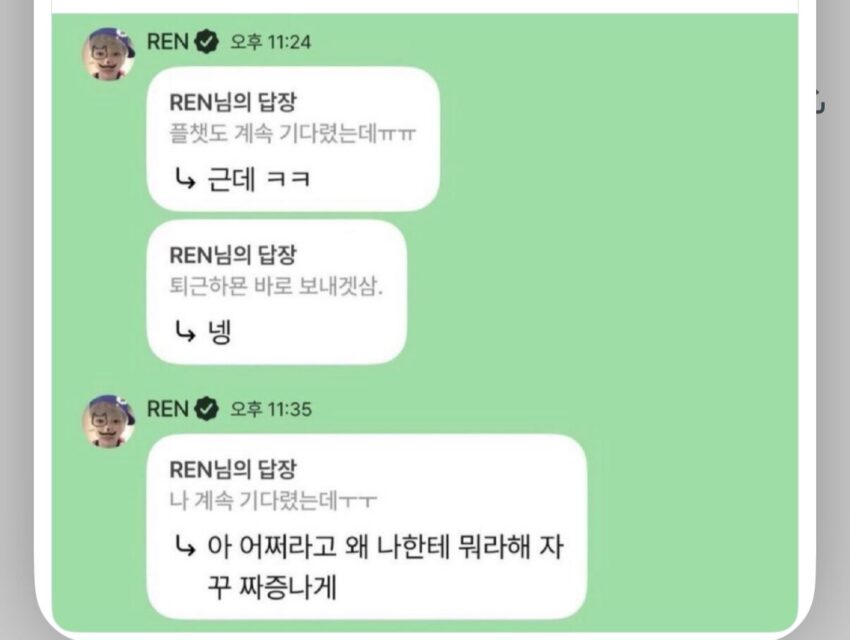
As Koreaboo reported, Ren of the rookie group CHASER became the subject of intense online criticism after messages he sent to fans were shared by a netizen. The messages were said to show an inappropriate attitude when responding to fans, leading to a wave of backlash. The term nugu was used in the original headline, a Korean slang expression meaning who that is often applied to lesser-known acts.
That label, while common in fandom spaces, can add a dismissive edge to coverage of a controversy involving a rookie group. The source reports that the messages were exposed and that criticism focused on Ren's tone.
The fan chat platform involved is PLUS CHAT, according to Howling Entertainment's later statement. The messages were released by a netizen and sparked what Koreaboo described as massive backlash. Since then, the messages have been deleted. The deletion does not erase the discussion they generated, and the episode has become a test of how a young artist and a small agency handle a public relations challenge.
For a group still building its audience, the speed and sincerity of the response can shape how the story is remembered.
It is important to note that the exact content of the messages has not been detailed in the source reporting, and the description of them as showing an inappropriate attitude comes from the backlash itself. Without the full context, observers are left to weigh the criticism against the apology and the agency's statement. The incident highlights how quickly private fan interactions can become public and how swiftly a controversy can escalate in the K-pop space.
Ren's Apology: Acknowledging Hurt And Promising Reflection
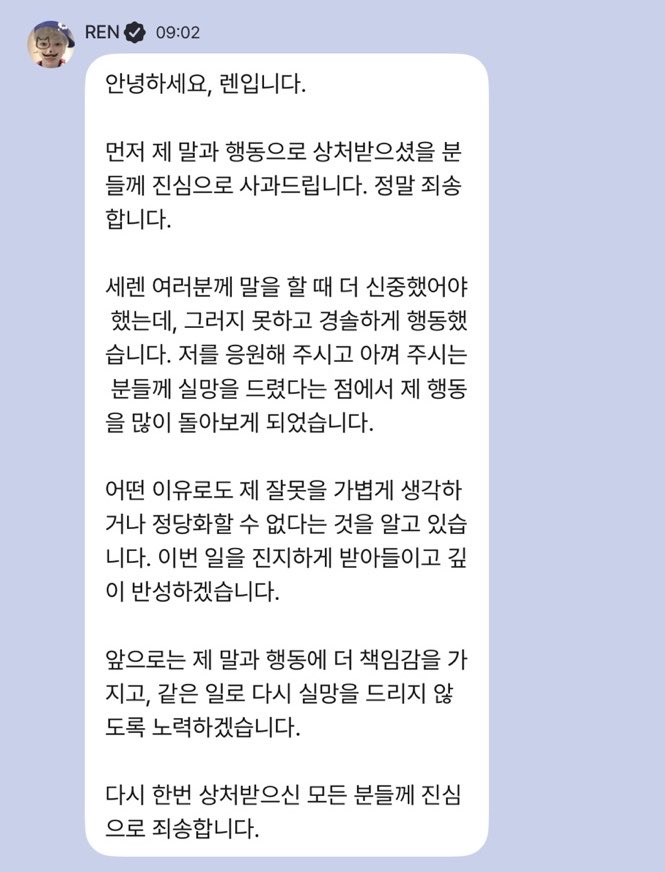
Ren issued an apology through the same fan messaging platform where the controversy originated. In his statement, he offered a sincere apology to those who had been hurt by his words and actions. He acknowledged that he ought to have been more careful when communicating with fans and that he had acted without due thought. He also said he had reflected on his behaviour and recognised that he had let down those who supported and cared for him.
The apology continued with Ren stating that he could not treat his actions as trivial or attempt to justify them. He promised to take the matter seriously and to reflect deeply. He also committed to bearing more responsibility for his words going forward and to ensuring that the same problem would not cause disappointment again. He ended by reiterating his apology to those who had been hurt.
The language of the apology is notable for its directness. It does not offer excuses or shift blame. Instead, it accepts that the words and actions were inappropriate and that they caused harm. For fans who felt let down, the key question will be whether the apology is followed by changed behaviour. Apologies in the K-pop industry are often judged not only by their wording but by the consistency of the artist's actions afterwards.
Howling Entertainment's Official Statement: Accountability And Education
Howling Entertainment, the agency behind CHASER, released an official statement on 12 October 2026. The statement began with a sincere apology to fans who were hurt by Ren's inappropriate words and actions. The agency acknowledged that it should have shown greater caution and responsibility towards fans, and it said it deeply reflected on the disappointment and hurt caused by careless words and behaviour.
Crucially, the agency singled out the communication with fans through PLUS CHAT. It stated that the inappropriate conduct there could not be excused for any reason and did not reflect the appreciation owed to fans. This is a significant admission: it validates the feelings of those who were upset and accepts that a line was crossed.
The statement went on to outline remedial steps. Howling Entertainment said it takes the matter very seriously and will strengthen its focus on artist education and management to stop similar incidents from happening again. It also promised to adopt a more careful and responsible approach in its communications with fans. The agency closed by once again apologising to all fans who were hurt. The emphasis on education and management suggests that the agency views this as a systemic issue, not just a one-off mistake.
Why The Speed Of The Response Matters
Both Ren and Howling Entertainment responded quickly. According to Koreaboo, Ren sent his apology not long after the backlash began. The agency statement followed, and the speed contrasts with cases where artists or companies wait days or weeks before addressing a controversy. A rapid response can help contain a story before it spirals further, but it also raises expectations that the reflection is genuine rather than a rushed attempt to calm the situation.
In crisis communication, timing is often seen as a signal of how seriously an issue is being taken. A swift apology can demonstrate awareness of fan sentiment, while a delayed one can allow speculation and anger to build. Here, the fact that the apology came through the same platform where the messages were exchanged may be an attempt to meet fans where the harm occurred. The agency statement then broadened the response to the official level.
However, speed alone does not guarantee a positive outcome. Fans and observers will look for follow-through. The agency's promise of closer artist education and management is a concrete commitment, but its effectiveness will only be visible over time. For a rookie group, establishing a pattern of responsible communication early on could be important for long-term reputation.
The Intimacy And Risks Of Fan Messaging Platforms
Fan messaging platforms such as PLUS CHAT have become a central part of K-pop fandom. They offer a space where artists can share informal updates and interact with fans in what feels like a direct, personal way. This intimacy is part of their appeal. Fans pay for subscriptions or access, and in return they receive messages that can feel conversational and unguarded. The format encourages a sense of closeness, but it also creates a record that can be screenshotted and shared.
The risk is that casual remarks made in a seemingly private setting can be taken out of context or judged by a wider audience. What might be intended as playful or offhand can be interpreted as rude or dismissive. The platform's informal nature can lower an artist's guard, making it harder to maintain the polished tone expected in official communications. When a message goes viral for the wrong reasons, the fallout can be immediate.
This incident underscores the need for artists and agencies to treat fan messaging with the same care as public statements, without losing the spontaneity that makes the platform appealing. It is a difficult balance. Fans want authenticity, but authenticity can be risky. The agency's statement acknowledged this tension by promising more cautious and responsible attitudes in fan communications while still recognising the value of fan attention. The challenge will be to enforce that caution without making interactions feel sterile.
The Nugu Label And The Pressure On Rookie Idols
The original headline used the term nugu to describe Ren. In Korean, nugu means who, and in K-pop fandom it is often used to refer to lesser-known or rookie acts. While some use it neutrally or even affectionately, it can also carry a dismissive tone. Applying it to a controversy can frame the story as a minor idol's misstep, potentially amplifying the scrutiny while also drawing attention to an act that might otherwise be overlooked.
Rookie idols face particular pressures. They are building a fanbase, often with limited resources and less margin for error. Every interaction can feel consequential. The desire to appear grateful and engaging can clash with the reality of human moods and mistakes. When a rookie makes a misstep, the consequences can feel disproportionate because they do not yet have the established goodwill that more senior artists may rely on.
For CHASER, the nugu label may add an extra layer of vulnerability. The group is still establishing its identity, and a controversy like this can become part of its early narrative. How the agency and the artist handle it could influence whether the story is remembered as a learning moment or a defining negative. The pressure to recover quickly is high, but so is the need for genuine reflection.
Deleted Messages And The Ethics Of Exposing Private Chats
According to the source, the messages released by the netizen have since been deleted. The deletion raises questions about the ethics of exposing private conversations. Fan chat messages are not public statements in the traditional sense, though they are shared with an audience. When they are screenshotted and posted elsewhere, the context can be lost. The identity and motives of the person who shared them are also unknown.
On one hand, fans have a right to hold artists accountable for how they speak to them, especially when the communication is part of a paid or semi-private service. On the other hand, the selective release of messages can paint an incomplete picture. Without knowing what prompted the messages or what else was said, it is difficult to judge the full exchange. The deletion of the original posts may make it harder to verify the claims.
This tension between accountability and privacy is not new in K-pop. The industry thrives on parasocial relationships, and those relationships can blur the line between public and private. Artists are expected to be accessible, but that accessibility comes with risks. In this case, the deletion does not resolve the underlying questions. It simply removes one set of evidence from public view, leaving the apology and the agency statement as the primary record.
Fan Expectations, Parasocial Bonds And The Demand For Accountability
K-pop fandom is built on intense emotional connections. Fans invest time, money and affection in artists, and in return they expect a certain level of respect and gratitude. When that expectation is perceived to be violated, the reaction can be swift and severe. The backlash against Ren fits this pattern. Fans who felt hurt by his words wanted acknowledgment, and they received it in the form of his apology and the agency's statement.
Parasocial relationships are one-sided by nature, but they feel real to those involved. Artists are aware of this, and many work hard to maintain a warm and appreciative persona. When a human moment breaks that persona, the disappointment can be profound. The demand for accountability is not just about the specific words; it is about the perceived breach of an unspoken contract between artist and fan.
The challenge for artists is to be authentic without being careless. The challenge for fans is to allow room for human error while still expecting basic respect. This incident sits at that intersection. The apologies aim to repair the bond, but trust is rebuilt through consistent behaviour, not just words. Fans will be watching Ren's future interactions closely, and the agency's promised education will be judged by results.
What This Means For CHASER And Ren's Next Steps
For CHASER, a rookie group still making its name, this controversy is a reputational test. The group's future depends on many factors, but how it navigates this moment could affect its relationship with its existing fanbase and its ability to attract new fans. The agency's public commitment to better education and management is a starting point, but it will need to be implemented in a way that feels meaningful rather than performative.
For Ren, the next steps are likely to involve a period of reflection and changed behaviour in fan communications. His apology was direct, and if he follows through, it may be possible to rebuild trust. However, the internet has a long memory, and the incident may resurface. The best defence is a consistent record of respectful interactions going forward.
It is also worth noting that the source reports the messages have been deleted. That removes some of the immediate evidence, but it does not erase the discussion. The story has already circulated, and the apology and agency statement are now part of the public record. How CHASER and Ren proceed will determine whether this becomes a brief blip or a longer-term setback. There is no guarantee of recovery, but the swift response gives them a foundation to build on.
Key Takeaways From A Fast-Moving Controversy
The CHASER Ren controversy is a reminder of how quickly fan interactions can become public and how high the stakes are for rookie idols. The sequence of events, from exposed messages to backlash to apology to agency statement, unfolded in a short space of time. The speed of the response may have helped contain the damage, but it also puts the focus on follow-through.
The incident highlights the double-edged nature of fan messaging platforms. They create intimacy and direct connection, but they also create vulnerabilities. Artists must navigate a space that feels informal yet can become very formal very quickly. Agencies must support them without stifling the authenticity that fans value.
Ultimately, the story is about accountability and repair. Ren apologised, the agency acknowledged its responsibilities, and both promised change. Whether that change materialises is now the central question. For K-pop listeners, the episode offers a case study in how fan expectations, artist behaviour and crisis management intersect. It is a story worth watching, not because of the drama, but because of what it reveals about the pressures on those who are still finding their footing.