
A 2014 album track is climbing Melon again
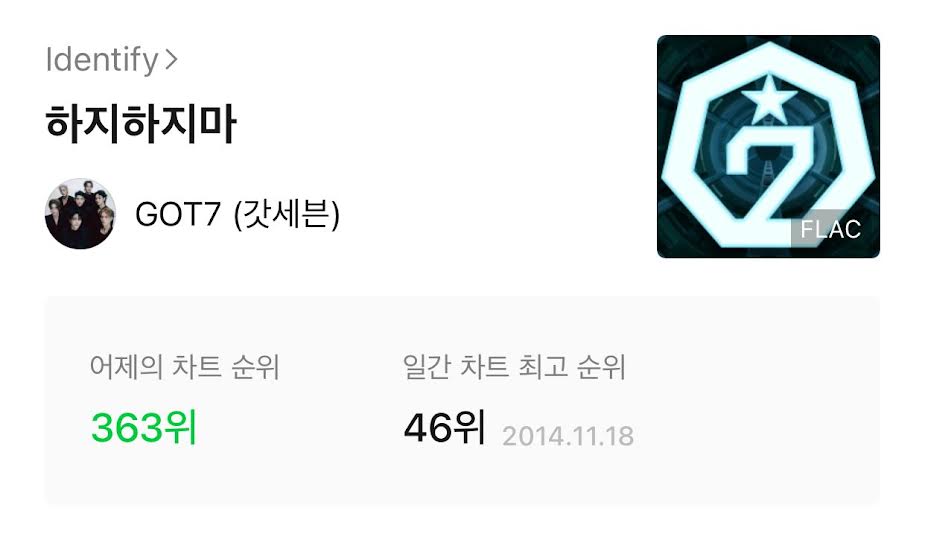
GOT7's "Stop, Stop It" has returned to Melon's Daily Chart more than a decade after it was released, according to a Koreaboo report published on 15 November. The track, which comes from the group's first full album, Identify, re-entered the daily ranking at 908 before climbing to 363 — a rise of 545 places in a matter of days, according to the report. It has stayed in the 300s since.
For a group that debuted in 2014 and has been talked about far more for its members' individual careers in recent years, the movement is a reminder that a chart entry is not always tied to a new release. Nothing here is a comeback, a re-release or a repackaging. It is an album cut from twelve years ago finding a new audience through a route that barely existed when it was recorded.
The practical significance is straightforward. A song that had long since dropped out of daily chart view is now visible to listeners browsing Melon again, and visibility is the currency that drives further listening. The interesting question is not really whether a twelve-year-old song can chart. It is why this one did, and what that says about how older K-pop material now circulates.
The numbers behind the reversal
The scale of the move is what makes the story notable. A re-entry at 908 on a daily chart is modest in itself — the kind of position a track can occupy briefly without anyone outside a devoted fandom noticing. Climbing to 363 and holding there is different. That is a sustained presence rather than a single day's blip, and the 545-place gap between the two figures is the clearest measure of how quickly the song's audience expanded.
Melon's daily ranking is a competitive space, and movement of that size usually reflects a concentrated burst of listening rather than a slow burn. That pattern — a sudden spike, then a period of hovering — is characteristic of what Korean music fans often call a chart reversal: an older song pulled back into view by something outside its original promotion cycle.
It is worth being precise about what the figures do and do not show. They place "Stop, Stop It" in the 300s on a daily chart, which is meaningful but not the same as a top-ten breakthrough, and a daily chart position describes a single day's listening rather than long-term commercial performance. The source does not specify exactly when the climb began or how long the song held each position along the way.
Idol dance challenges did the reintroducing
The mechanism behind the rise is the part that makes most sense for a younger listener encountering the song for the first time. According to Koreaboo, "Stop, Stop It" began being used in dance challenges by a number of idols, and the song's chart re-entry followed in mid-November. That is a peer-to-peer recommendation at scale: idols filming themselves dancing to a track and posting it, with their own fandoms then seeking the song out.
This is now one of the main ways older K-pop songs come back. A challenge clip does something a retrospective playlist cannot — it puts a specific hook, chorus or piece of choreography in front of an audience that has no memory of the original promotion. The viewer's next step is usually to find the full song, and the full song turns out to be sitting on streaming services, unchanged and immediately available.
The source does not name which idols took part or give a precise start date for the challenge wave, so the exact sequence of who posted what and when remains unclear. What is clear is that the pattern repeated often enough to shift a daily chart position by more than five hundred places, which implies a fairly wide spread rather than a single viral post.

The irony: a concept the members disliked
The detail that has given the story its extra life is that GOT7 were not fond of the song's concept at the time. Members have previously discussed disliking their hairstyles for the era and comparing the outfits to those worn by fish market workers, as Koreaboo notes. That is the kind of self-deprecating recollection that tends to age into affectionate mythology in K-pop fandom.
There is a genuine tension in a song succeeding precisely as its visual presentation is being gently mocked by the people who performed it. Yet the two things are separable. A styling direction is a marketing decision made around a release; a song is the recording underneath it. Time tends to break the link between them, and listeners arriving twelve years later encounter the track with no memory of the hair, the outfits or the promotional campaign that the members found awkward.
That separation is probably the most interesting thing about this story. The version of "Stop, Stop It" climbing Melon now is not the same cultural object it was in 2014. Stripped of its original context and reintroduced through short dance clips, it functions as a piece of music rather than a moment in a promotional cycle. The members' criticism of the concept does not undercut the resurgence; in a sense, it confirms that the song has outlived the packaging.
Why early album cuts keep resurfacing
Chart reversals have become a familiar feature of the Korean charts, and they tend to follow a similar shape. Something outside the original release — a challenge, a variety segment, a cover, a drama sync — reintroduces a track, and the listening follows. What has changed is the speed and the scale, because the reintroducing now happens on platforms where a clip can be seen by millions before a song's original promotion is even a distant memory.
There is also an arithmetic reason older material benefits. Groups that debuted in the early 2010s built catalogues at a time when a full album was expected to contain a dozen or more tracks, many of which received no promotion at all. That leaves a deep reserve of songs that most listeners have never heard, some of which are better suited to a fifteen-second clip than the singles chosen at the time.
A B-side can end up with a second life the title track never needed.
For GOT7 specifically, the timing sits alongside a longer story. The group debuted in 2014 and have remained active since leaving JYP Entertainment as a whole in 2021. In a period when fans are watching for the next group move, an unexpected chart entry from the back catalogue keeps the name in circulation without requiring anyone to announce anything.

What a chart reversal actually delivers
It is worth resisting the temptation to read a chart reversal as a commercial turning point. A song returning to the 300s on a daily chart generates attention, a fresh round of articles and a reason for newer listeners to explore an old album. It does not, on its own, indicate a sustained rise, a forthcoming release or a change in a group's plans, and the source reporting here does not suggest any of those things.
What it does demonstrate is the durability of the catalogue. Twelve years is a long time in K-pop, long enough that a group's early material can pass out of general conversation entirely. A sudden 545-place climb shows that the material was not forgotten so much as dormant, waiting for a route back into view. The route happened to be dance challenges this time; next time it will be something else.
There is a reasonable caution to attach here as well. Chart movements driven by a burst of interest can recede as quickly as they arrive, and a song hovering in the 300s is not guaranteed to stay there. The reporting notes that it has held in that range since the climb, which is a stronger signal than a single-day spike, but daily charts reward momentum and are quick to move on.
The takeaway
GOT7's "Stop, Stop It" is having a moment it was never designed to have. A track from a 2014 debut album, promoted in styling the members themselves have since joked about, has been pulled back onto Melon's daily chart by idols dancing to it — and has climbed 545 places to sit in the 300s. The song did not change; the way people find songs did.
That is the useful lesson for anyone watching the charts. Resurgences like this are less a verdict on a group's current standing than a snapshot of how quickly a good hook can travel when the right people point at it. For GOT7, it means an early album track is getting a hearing from listeners who were not there the first time, and the members' least favourite styling era has inadvertently become one of the group's more effective calling cards.
Whether the song holds its position is a question for the daily chart rather than for the song itself. The interesting part has already happened: twelve years on, people went looking for it.