
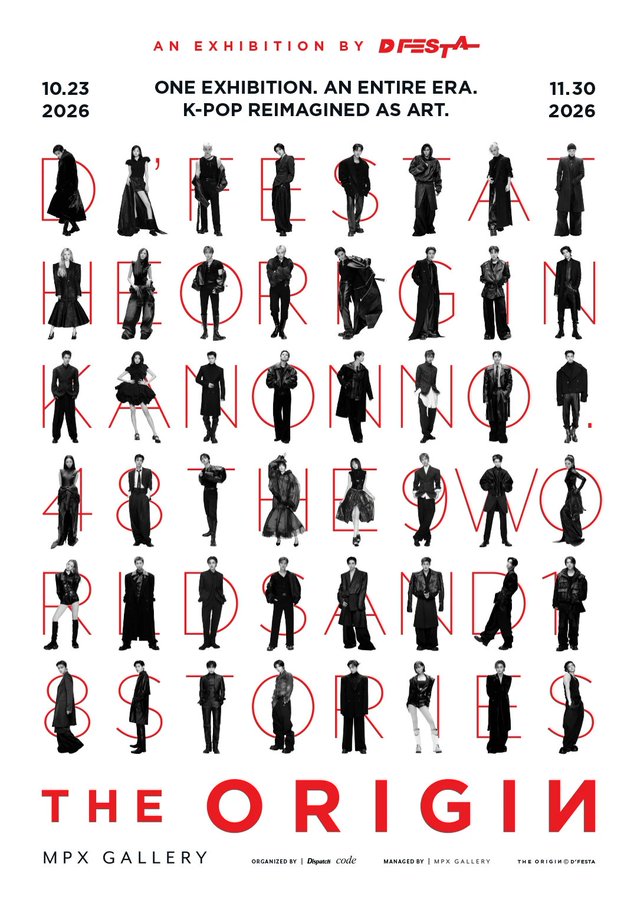
Dispatch Moves From Scoops to an Exhibition Hall
On 14 October 2026, the KoreaDispatch account shared a video for D'FESTA THE ORIGIN, an immersive K-pop exhibition, according to Koreaboo's report. The clip gathers what the report describes as members of BTS, TXT, G-Dragon, IVE, aespa and many more, with the accompanying post referring to 48 artists. For an outlet whose name is most often attached to relationship reveals, the immediate significance is the shift in register: the same operation is now presenting a curated cultural project rather than a news break.
The video arrived ahead of the exhibition. That timing matters because it turns the announcement into a teaser for a physical or digital experience rather than a single story. Fans did not respond with the usual anticipation for a gallery opening. They responded with jokes about why so many top-tier acts would appear in one Dispatch-linked project. That reaction is now part of the story.
What the Shared Post Says About K-Pop Memory
The post's own framing is more earnest than the fan replies. It asks how K-pop of this era should be remembered, and describes 48 artists moving at different speeds as notes crossing a giant musical score. The phrase about turning a fleeting moment into an eternal record appears alongside the exhibition's name. This is the language of archiving: a claim that pop performance deserves preservation, not just coverage.
The report does not specify exhibition dates or a venue, so the practical details remain unclear from the text alone. What is clear is the curatorial pitch: a large, cross-artist snapshot of a period, presented as something to be experienced rather than merely read about. The number 48 is doing a lot of work in that pitch, because it implies breadth while leaving the full list to the exhibition itself.
Why the Lineup Draws Attention
The named artists come from different companies and different points in their careers. Bringing that range under a single exhibition banner is unusual, not because collaboration never happens, but because exhibitions require image rights, scheduling and a level of institutional trust that a one-off performance or award show does not.
The report lists only a handful of names and says there are many more. That openness is part of the draw. Readers can look at the partial roster and understand the scale without being able to calculate the full guest list. In K-pop, where agency boundaries often shape what fans see, a project that crosses those boundaries invites questions about who negotiated it and what each side gets from participating.
The Fan Jokes About Tea and Leverage
The reaction on X, as reported by Koreaboo, was less about the exhibition and more about Dispatch's reputation. One user joked that nobody wanted their business exposed. Another suggested a company had renewed a contract with Dispatch so that their favourites' business would not appear on its front page. A third said Dispatch must have pulled out its archive of photos to get the groups under one roof. Another simply asked how Dispatch was getting BTS to do these things.
These are jokes, and they should be read as such. They are built on a well-known fact about Dispatch's output, which is that it has a history of revealing Korean couples. The humour works by imagining that the same access used for news breaks is being used to assemble an exhibition. The report offers no evidence that any artist participated under pressure, and the fan posts do not claim to have any.
What they reveal is a public image problem, or perhaps a public image joke, that follows Dispatch even when it changes lanes.
A News Brand Experiments With Curation
The move from breaking relationship stories to presenting an immersive exhibition is a change of genre. News outlets often extend into events, awards and festivals, but the transfer is rarely this visible. Dispatch's brand has been built on access and disclosure. An exhibition asks for a different kind of trust: visitors must believe the presentation is worth their time and that the artists are not simply being used as decoration.
The fan theories capture that tension neatly. If an outlet is known for exposing private lives, its attempt to frame a period of pop history will be met with suspicion as well as curiosity. That does not make the exhibition cynical by default. It does mean the project will be judged on how it treats the artists, not only on how many it can gather.
What Immersive Could Mean Here
The report describes The ORIGIN as immersive but does not detail the format. In practice, immersive K-pop exhibitions can range from projection rooms and sound installations to photography displays and interactive sets. The lack of specifics in the report leaves the experience undefined, which is normal for a teaser. It also means the video is doing the heavy lifting: it must communicate scale and mood without showing the exhibition itself.
Readers might reasonably ask what is being preserved. Is it performance, image, sound, or the feeling of fandom? A canon-style project that centres 48 artists will inevitably make choices about who represents an era and how. Those choices are curatorial, and they are open to debate. Fans are already used to debating lineups, rosters and award nominations. An exhibition invites a similar conversation, but with a longer memory attached.
The Weight of the Word Canon
The post includes the word KANON, and the phrase KANON NO.48. A canon is not a neutral list. It is a claim about significance, and in pop music it is always contested. Naming 48 artists is a way of drawing a boundary around a moment while admitting that the moment is too large for a single act or agency. The video's Korean text leans into that idea by describing artists as intersecting notes rather than competitors.
Because the report gives only part of the roster, the full scope remains a question. Fans will want to know who else is included, how the 48 were selected, and whether the exhibition treats all participants equally or organises them by generation, genre or company. None of those answers are in the supplied report, and the video alone cannot settle them. The interest lies in the fact that the questions exist at all.
The Takeaway
The ORIGIN is not notable simply because another K-pop exhibition is opening. It is notable because of who is behind it and who agreed to appear. Dispatch has built a reputation on access to private information. Now it is asking audiences to see it as a curator of public memory. The fan jokes about tea are funny because they name the gap between those two roles.
The practical thing to watch is how the exhibition presents its 48 artists once more details emerge. If it treats them as archival subjects with care, the shift could be more than a novelty. If it treats them as a roster of names, the jokes will keep writing themselves. Either way, the video has already done what a good teaser should: it has made the audience ask what the project is really for.
